What Makes ClaudeKit Special Compared to Open Source Kits?
"What makes ClaudeKit special compared to all the open source kits out there?"
This is the question I get asked the most since I started building ClaudeKit. Every single week, someone asks.
One day it's "Compare CK with BMAD", another day it's "Superpowers is free, why pay for CK?", and then "carlrannaberg also has a claudekit, how is CK different?"
Every time someone asks that question, I always give the exact same answer:
QUALITY > QUANTITY.
You don't need 100K skills
Nooo... I'm serious. You don't need 100,000 disconnected skills. You only need 1 ecosystem — where skills are tightly interconnected to get the job done better.
This is the problem most open source kits out there have: their skills work independently. Each skill is its own island. Skill A doesn't know Skill B exists. Skill B can't call Skill C. You have to manually "wire" everything together yourself.
CK is different. 54 skills. 80+ connections. Each skill cross-calls others to complete tasks in the best way possible.
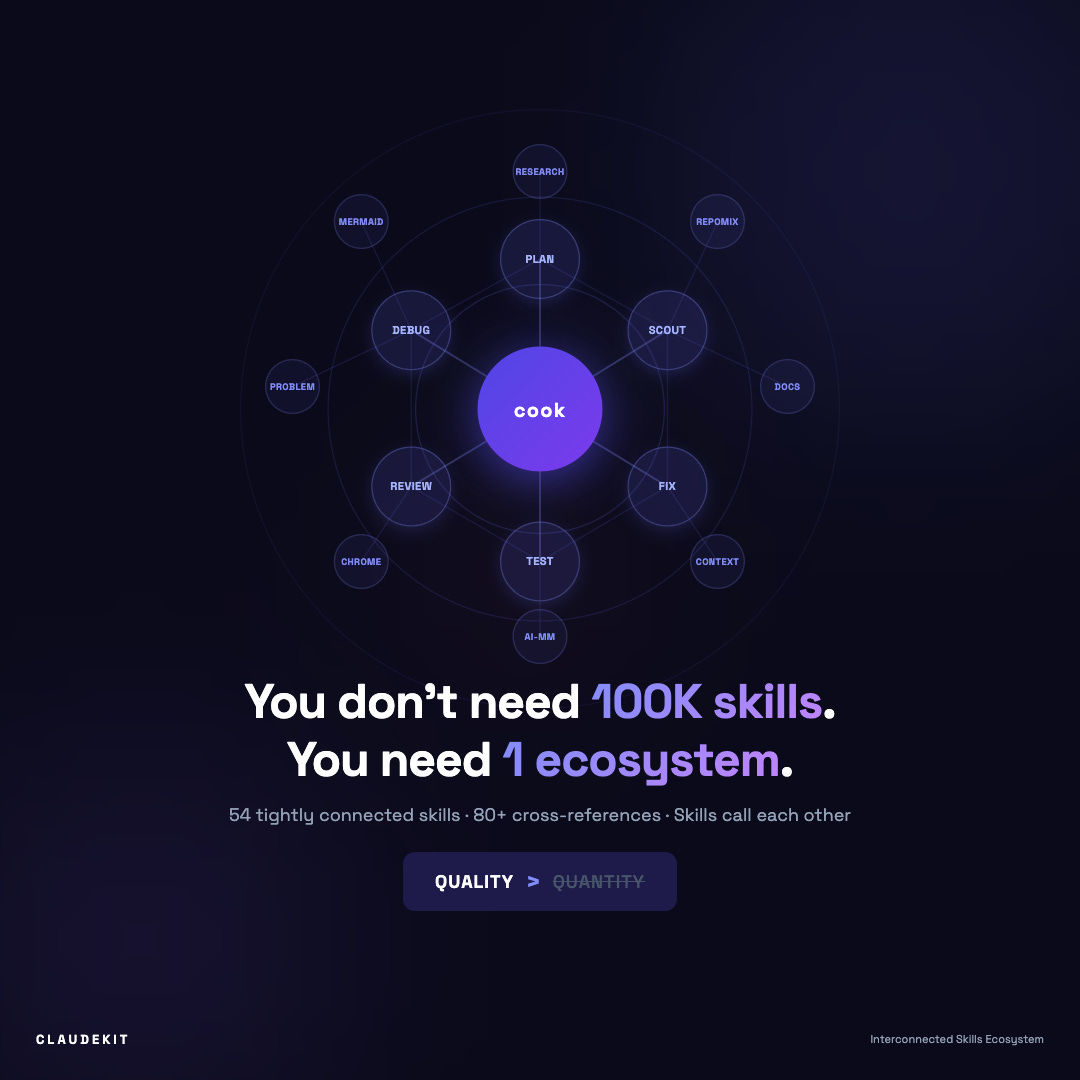
Why "interconnection" matters more than "quantity"
Here's an example. You use /cook to implement a new feature. Behind the scenes, cook doesn't work alone — it orchestrates an entire ensemble of skills:
1/ plan designs the architecture and analysis → calls research to gather information → calls scout to scan the current codebase
2/ debug when errors occur → calls docs-seeker to look up documentation, repomix to pack the repo, chrome-devtools to inspect the browser, problem-solving to analyze root causes
3/ fix repairs bugs → calls debug to find root cause, code-review to check quality, brainstorm if creative solutions are needed
4/ test validates → calls ai-multimodal for visual testing, chrome-devtools for browser testing
5/ code-review evaluates → calls scout to find edge cases
6/ git commits and pushes → calls context-engineering to manage context → project-management and docs-management to update the roadmap and documentation
All of this happens automatically. You just type /cook "implement feature X" — CK handles the rest.
Compare with BMAD — 9 skills, 15 commands, primarily focused on agile planning processes. Great for planning, but when it comes to implementation, you're on your own. Superpowers — focuses on TDD workflow and brainstorming, 42K+ stars on GitHub, also very good. But it's still a linear pipeline.
CK is not a pipeline. CK is a mesh network.
Skills call back and forth, forming a resilient network. Not a rigid tree — but a living mesh.
Another example: the banner-design skill
The name tells you what it does — create banners. But what matters is how it does it.
Claude Code opens Chrome, browses Canva, Pinterest, and Dribbble to check the latest design trends. Then calls ui-ux-pro-max to design in HTML format with design tokens, color palette, and typography. Combines with ai-multimodal and ai-artist skills. Finally exports to JPG/PNG/PDF using chrome-devtools.
Just one skill calls 5-6 other overlapping skills. That level of interconnection is impossible with independently installed skills.
4-Layer Architecture
CK uses a hub-and-spoke model with 4 layers:
Layer 1 — Orchestrators: cook, team, bootstrap — the commanders
Layer 2 — Workflow hubs: plan, scout, debug, fix, test, code-review, brainstorm — the middle managers
Layer 3 — Utility providers: research, docs-seeker, sequential-thinking, ai-multimodal, chrome-devtools, repomix — pure capabilities, stateless
Layer 4 — Standalone skills: 27 domain-specific skills — agent-browser, databases, devops, shopify, threejs...
The beauty is cross-hub references — Layer 2 skills cross-call each other, forming a resilient mesh. And team wraps everything for multi-session parallel work.
Most importantly
All CK skills are safe and secure — no worries about prompt injection, malware, or security vulnerabilities.
In summary
The open source kits are all good. BMAD is great for planning. Superpowers is great for TDD.
But CK plays a different game. CK tries to create the best-interconnected workflow and dig deepest into its niche.
54 tightly interconnected skills > 540 disconnected skills.
Disclaimers: All those open source kits are worthy of respect. CK learned a great deal from them. Each tool fits different needs. I believe in "quality > quantity" and CK is being built in that direction.